



4052 Dual 4-Channel Analog Multiplexer/Demultiplexer DIP-16
14,52 EGP
4052 Dual 4-Channel Analog Multiplexer/Demultiplexer DIP-16
4-Channel Multiplexer and Demultiplexer IC
The CD4052 is a 4-Channel Multiplexer and Demultiplexer IC. It can either be used as a 4:1 Multiplexer or a 1:4 Demultiplexer. The IC supports both Analog and Digital voltages and is hence widely used in many designs.

Pin Configuration
Pin Number |
Pin Name |
Description |
16 |
Vdd |
Positive power input, maximum 20V |
7 |
Vee |
Negative power rail, normally connected to ground. |
8 |
Vss (Ground) |
Connected to the ground of the circuit |
6 |
INH |
Enable pin – Must be pulled to ground for normal operation |
9,10 |
A, B |
Channel Select pins |
1,12 |
Y0,X0 |
Channel 0 Input / Output |
5,14 |
Y1,X1 |
Channel 1 Input / Output |
2,15 |
Y2,X2 |
Channel 2 Input / Output |
4,11 |
Y3,X3 |
Channel 3 Input / Output |
3,13 |
Y, X |
Common Output / Input |
Features
-
- 4-Channel Mux and Demux
- 4:1 Multiplexer IC
- 1:4 Demultiplexer IC
- Supports both Analog and Digital Voltage
- Nominal Voltage: 5V, 10V, 15V
- Maximum Operating Voltage: 20V
- Propagation Delay: 400ns at 5V
(Note: Complete Technical Details can be found on the CD4052 datasheet given at the end of this page.)
A |
B |
Channel Selected |
0 |
0 |
Channel 0 |
1 |
0 |
Channel 1 |
0 |
1 |
Channel 2 |
1 |
1 |
Channel 3 |
The complete working of a 4:1 MUX using the CD4052 simulation is shown in the video below, the image here shows a snapshot of it.

Where to Use CD4052 IC
The IC CD4052 is a CMOS-based high-voltage Multiplexer and Demultiplexer IC. Therefore, the IC is commonly used in circuits where a 4:1 MUX or a 1:4 DEMUX is required in a Programmable Logic circuit Design. Furthermore, since it can handle both analog and digital voltages, it’s perfect for use in Analog-to-Digital and Digital-to-Analog converters.
CD4052 as a 4:1 Multiplexer
The CD4052 can be used as a 4:1 Multiplexer, meaning it can take inputs from four channels and convert them to a single-channel output based on the channel select pins. In this case, the four input channels are X0Y0, X1Y1, X2Y2, X3, and Y3, while the single output channel is X, Y. Ultimately, the output on the single channel is decided based on the channel select pins A and B. The state of the select pins and channel selection is shown in the table below:

CD4052 as a 1:4 Demultiplexer
Conversely, the CD4052 can be used as a 1:4 Demultiplexer. In other words, it can take one input and provide it to one of the four output channels based on the channel select pins. Here, the input pins will be X and Y. The output pins can be X0, Y0, or X1, Y1, or X2, Y2, or X3, Y3, depending on the value set on A and B pins. (We have already discussed how to select the channel using pins A and B in the above table.)
The above image shows the simulation of the CD4052 in a demultiplexer circuit; the complete working can be found in the video linked below. Specifically, as you can see here, channel 2 is selected by making A as 0 and B as 1. Therefore, the input given to pin X and Y is reflected on the channel 2 X2 and Y2 pins.
Applications
- Multiplexer and Demultiplexer circuit
- A/D and D/A converter circuits
- Network switching
- Programmable Logic circuits.
4052 Datasheet
Related products


4053 SMD IC Triple 2-channel Analog Multiplexer/Demultiplexer SOIC-16
In stock


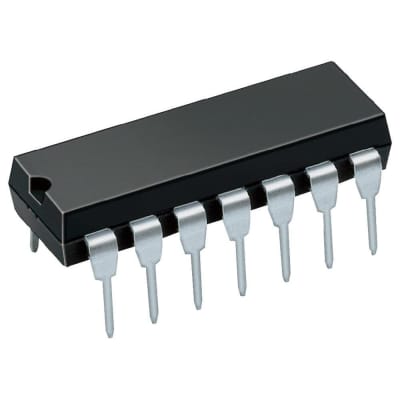
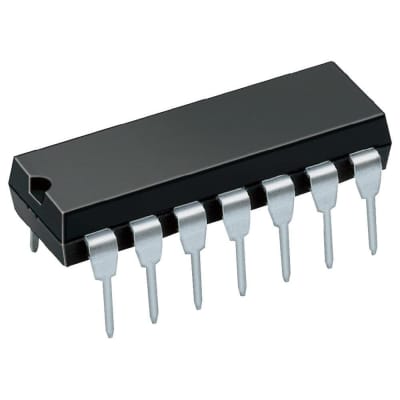







S8036 SOP8 for Mini Receiver IC Signal or Power Compatible with Sunplus Receiver
In stock

TDA2549 I.F. amplifier and demodulator for multistandard TV receivers
In stock






Reviews
Clear filtersThere are no reviews yet.